
Best Time to Trade XAUUSD: London vs New York Sessions Explained

If you’ve ever placed a XAUUSD trade during the wrong hours and watched price grind sideways for hours before hitting your stop loss, you already know the problem. Gold doesn’t move the same way all day. At certain times, it trends cleanly with tight spreads and strong directional momentum. At others, it chops in a narrow range, taking out stops on both sides while institutions sit on their hands.
The difference between those two environments usually comes down to one thing: timing.
In this guide, we break down every major XAUUSD trading session – what drives each one, when liquidity peaks, and exactly which hours give retail traders the best conditions for clean, high-probability setups.

Why Timing Matters More in Gold Than in Most Forex Pairs
XAUUSD is one of the most volatile instruments available to retail traders. Daily ranges of 200 to 500+ pips are common — sometimes more when major economic data lands. That volatility is a feature, not a bug. But it cuts both ways.
During peak liquidity hours, that volatility produces clean, trending price action with tight spreads and fast execution. During low-liquidity hours, the same volatility becomes noise – erratic, choppy movement that doesn’t respect structure and punishes traders who misread it as a genuine signal.
Gold is also unique in that it sits at the intersection of multiple global markets. It’s priced in US dollars, heavily traded in London, benchmarked twice daily by major bullion banks, and futures-settled in New York through COMEX. That means the market’s behaviour changes dramatically depending on which of the world’s financial centres is actively open.
Understanding which session you’re trading – and what’s typically happening in that session – is one of the simplest, most underrated edges available to any gold trader.
The Four Trading Sessions: A Quick Overview
XAUUSD trades 24 hours a day, five days a week, from Sunday evening to Friday evening. Across that window, activity flows through four regional sessions:
- Sydney session: 10:00 PM – 7:00 AM GMT
- Tokyo session: 12:00 AM – 9:00 AM GMT
- London session: 8:00 AM – 5:00 PM GMT
- New York session: 1:00 PM – 10:00 PM GMT
These sessions overlap at certain points – and those overlaps are where the real action happens. The two that matter most for XAUUSD traders are the London open and the London–New York overlap.
The Asian Session (Sydney + Tokyo): When to Stay Away
The Asian session runs roughly from midnight to 9:00 AM GMT, covering Sydney and Tokyo trading hours. For most XAUUSD traders, this is the session to avoid — or at least to approach with significantly reduced position sizes.
During Asian hours, gold trading volume drops sharply. The major institutional participants — European bullion banks, COMEX futures desks, and US macroeconomic traders — are either closed or not yet active. Without that institutional order flow, price action tends to be range-bound and directionless.
You’ll often see XAUUSD oscillate within a 20–40 pip range during the Asian session, with occasional spikes if major data comes out of Australia, China, or Japan. But those spikes are frequently reversed almost immediately, making them difficult to trade profitably.
There is one important thing the Asian session does give you: the Asian range. The high and low established during Asian hours serve as reference levels for the rest of the day. Smart Money Concepts traders specifically watch these levels because London frequently hunts above or below the Asian high/low at the open — and that liquidity sweep is often what sets up the day’s primary trade direction.
Asian session summary:
- Volume: Low
- Spreads: Wide
- Price behaviour: Range-bound, directionless
- Best use for traders: Mark the Asian high and low. Don’t trade it.
The London Session (8:00 AM – 5:00 PM GMT): Where the Day’s Direction Is Set
The London session is the second-most important session for XAUUSD, and for many traders using SMC or ICT methodology, it’s where the most important price action of the day begins.
London opens at 8:00 AM GMT. This is when European institutional participants — including the world’s largest bullion banks — come online. Volume increases dramatically within the first hour, spreads tighten, and price begins to move with purpose.
The London Open Kill Zone (8:00 AM – 10:00 AM GMT)
The first two hours of the London session are what ICT traders call the London Kill Zone. This window consistently produces some of the strongest, most directional moves of the day on XAUUSD, and for good reason.
At the London open, price will frequently sweep the Asian session high or low — hunting the liquidity that accumulated overnight above resistance or below support. Retail traders who placed stops just beyond those levels get taken out, which fills institutional orders at better prices. After the sweep, price typically reverses and moves in the day’s primary direction.
This is one of the most reliable, repeatable patterns in the XAUUSD market. If you understand SMC structure, you’re watching the Asian range, waiting for the liquidity hunt at London open, and then looking for entry confirmation on a lower timeframe as price reverses.
London PM Fix (3:00 PM GMT)
Another key event within the London session is the London PM Gold Fix at 3:00 PM GMT. This is a daily benchmark price set by major bullion banks to settle institutional gold contracts globally. It consistently causes a spike in activity at that hour, often producing short, sharp moves as the fix is calculated and participants respond. Traders should be aware of this window — it can disrupt otherwise clean setups if you’re caught on the wrong side.
London session summary:
- Volume: High
- Spreads: Tight
- Price behaviour: Directional, often starts with a liquidity sweep
- Best for: SMC/ICT traders watching the London Kill Zone, trend-following strategies
- Key event: London PM Fix at 3:00 PM GMT
The New York Session (1:00 PM – 10:00 PM GMT): The Highest Volume Window
If you could only trade one session, the New York session — and specifically its overlap with London — is the one to choose.
The New York session opens at 1:00 PM GMT (8:00 AM EST). This is when US economic data hits. NFP, CPI, FOMC decisions, PPI, GDP releases — all of these land during the New York session, and gold reacts sharply to all of them. Because XAUUSD is priced in US dollars, any data that moves the dollar creates an immediate, often significant reaction in gold.
But beyond the news, the New York session brings a structural advantage: it’s when COMEX — the world’s primary gold futures exchange — is most active. COMEX futures volume adds another layer of institutional order flow to the market, reinforcing directional moves and deepening liquidity.
The New York Open Kill Zone (1:00 PM – 3:00 PM GMT / 8:00 AM – 10:00 AM EST)
Just as London has its Kill Zone, ICT methodology identifies a New York Kill Zone at the NY open. This two-hour window regularly produces strong, clean moves — particularly on days with US economic data. Price will often run to take out London session highs or lows before establishing the continuation or reversal that defines the afternoon trade.
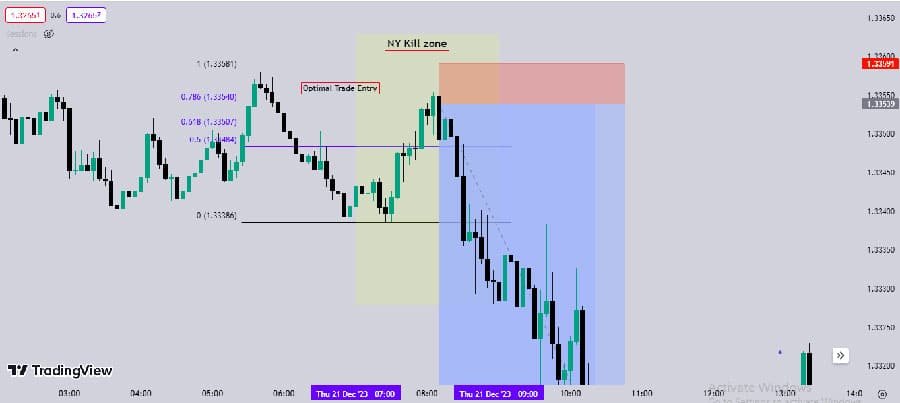
For traders in US time zones, this window is arguably the most accessible and most consistent opportunity of the trading day.
New York session summary:
- Volume: Highest of the day
- Spreads: Very tight during overlap
- Price behaviour: Strongly directional, news-driven, frequent continuation of London direction
- Best for: All styles — scalpers, day traders, and short-term swing traders
- Key event: US economic data releases (CPI, NFP, FOMC)
The London–New York Overlap (1:00 PM – 5:00 PM GMT): The Best Four Hours in Gold
From 1:00 PM to 5:00 PM GMT (8:00 AM to 12:00 PM EST), both London and New York are simultaneously active. This four-hour window is, without question, the best time to trade XAUUSD.
Here’s why:
Maximum liquidity. Both the OTC spot gold market centred in London and the COMEX futures exchange in New York are running at full capacity simultaneously. The combined institutional order flow is higher during these four hours than at any other point in the trading day.
Tightest spreads. With more market participants competing for trades, spreads on XAUUSD narrow to their daily minimum. This directly reduces the cost of every trade you place — a consistent edge that compounds significantly over time.
Cleanest price action. High liquidity and institutional participation means price respects structure better. Order blocks hold. Fair value gaps fill cleanly. Break-of-structure events are followed by genuine continuation rather than fake-outs.
Most impactful news. The majority of major US and European economic data releases — the data points that move gold the most — land during this window. CPI, NFP, Fed statements, PMI data: all of these arrive while both sessions are active, producing the strongest, most sustained directional moves of any time in the trading day.
Research across 12 months of XAUUSD hourly data consistently shows that gold establishes its daily high or low during the London–New York overlap window roughly 70% of trading days. If you want to catch the day’s primary move, you need to be watching during these four hours.
Best Days of the Week to Trade XAUUSD
Session timing isn’t just about hours — the day of the week matters too.
Tuesday and Thursday are historically the most productive days for XAUUSD traders. Volume is consistent, institutional participation is high, and directional moves tend to follow through cleanly.
Wednesday is important if there is a major US data release or a Federal Reserve announcement. FOMC meeting days produce some of the largest single-session moves in gold, often 300–500+ pips.
Monday is the weakest day. Volume is lower as the market digests any weekend developments, and price tends to range or consolidate before committing to direction. Many institutional desks don’t size up positions on Monday.
Friday is a day to be careful. The morning can produce good setups, particularly around NFP if it falls on that day. But liquidity drops sharply after 2:00 PM GMT on Fridays as traders close positions before the weekend, producing choppy and unpredictable price action.
Practical Application: How to Structure Your XAUUSD Trading Day
Based on everything above, here’s how a structured XAUUSD trading day looks in practice:
Before the London open (before 8:00 AM GMT): Mark the Asian session high and low on your chart. These are your key liquidity levels for the day.
London Kill Zone (8:00 AM – 10:00 AM GMT): Watch for a liquidity sweep of the Asian range. If price sweeps above the Asian high and then breaks back below, look for short setups aligned with HTF (higher timeframe) structure. If it sweeps the Asian low and reclaims it, look for longs.
Mid-London (10:00 AM – 1:00 PM GMT): Price often consolidates or continues in the direction established at the open. New setups are possible but require more discretion.
NY Open Kill Zone / Overlap start (1:00 PM – 3:00 PM GMT): This is the highest-conviction window of the day. Watch for continuation of the London direction, or a reversal that sweeps London session highs/lows before moving the other way. This is where the day’s best risk/reward setups typically form.
Overlap continuation (3:00 PM – 5:00 PM GMT): Trend continuation moves as the established direction plays out. Manage open trades, take profit at targets.
Post-London / Late New York (5:00 PM – 10:00 PM GMT): Volume drops after London closes. Setups become lower quality. Consider stepping away unless a major news event is scheduled.
Asian session (10:00 PM – 8:00 AM GMT): Don’t trade. Mark levels. Rest.
The Bottom Line
The single most impactful thing most XAUUSD traders can do — regardless of their strategy — is stop trading during low-liquidity hours and concentrate their activity on the London Kill Zone and the London–New York overlap.
These windows offer tighter spreads, stronger directional moves, cleaner structure, and the highest probability that the price action you’re reading is genuine institutional activity rather than noise.
Gold is already one of the most opportunity-rich instruments available to retail traders. When you combine a solid methodology — like Smart Money Concepts — with proper session timing, the quality of your setups improves dramatically.
If you want to see this applied in real time, join the Smart Forex Pips Telegram channel. Every day, we publish XAUUSD and EURUSD analysis built on SMC/ICT methodology, with clear entry zones, stop loss levels, and take profit targets — all timed around the sessions covered in this guide.
Risk disclaimer: Trading forex and gold involves significant risk. Past analysis is not indicative of future performance. This article is for educational purposes only and does not constitute financial advice.